Well, it's started. The two weeks of aimless drifting. Well, it's not exactly aimless, but it sure is drifting. And so far, things are not looking good.
My housing contract ran out last Friday, but I still had two more weeks of work to be finishing up. So where would I live for that time? Not a problem. I talked to management at my complex, who agreed that if it was OK with the new tenants moving in to my old apartment, I could stay on the couch there for two weeks.
So I talked to the new tenants. There are three of them. They're all freshmen. Now, I remember being a freshman and being annoyed at how everyone would look down on us like vermin of the world. But sometimes, it's warranted. I have nothing against these freshmen (or any freshmen) personally, but they are still enthralled by the fact that they can stay up until 3:00 am, eat cold cereal five times a day, and sleep in until all conceivable hours ... and MOMMY'S NOT HERE TO STOP US!!
Anyway, I talked to the freshmen to see if it would be OK with them for me to sleep on the couch for the next two weeks. No problem, they said.
So last night I came home from work rather late, and then went with my neighbor to run an errand. Around 10:30, I got home, hoping to be able to get in bed within an hour or so. I thought I'd watch TV for a while with the new roomies. That didn't go over so well. On my end, not theirs. They were watching things like Elimidate (help!) and the Olympics (not a problem), and making silly or just plain stupid comments (that's a problem). My favorite moment came when they were running the gamut of channels during a commercial break. They stopped for a while on The Cosby Show to make fun of their dorky dancing. That I'm OK with -- the 80s were a very odd and often dorky time. But then Malcom Jamal-Warner (aka Theo Huxtable) walked on set and one of the freshers said, "Look at him, he's from The Cosby Show." Trying hard to mask my disbelief, I replied, "This is The Cosby Show." "Oh," she muttered, "I thought it was, like, In Living Color or something." At that moment I realized that I am 6 to 7 full years older than these girls. I went to the neighbors' for a while.
After watching a movie with the neighbors, I went back to the old apartment around 1:00 am, part of me hoping that someone would still be up to let me in, part of me really dreading having to face them again. No one was up (as far as I could tell), but the door was still unlocked. I went in and the first thing I saw was ... someone else sleeping on the couch! One of the freshers! On my couch! The couch I specifically asked to sleep on for the next two weeks! I was appalled. Closing the door quietly, I heard her mutter, "You can sleep on my bed if you want." I don't want! I don't know you, I don't want to sleep on your bed, I want to sleep on my couch! I quickly dressed for bed, got my pillow and blanket, and headed back to the neighbors' house. They were kind enough to let me sleep on their couch.
The bright side? I woke up around 7:45 this morning. That's a record-setting early wake time for me for the last few weeks.
Talking to one of the guys at work about all of this, he pointed out that the situation is not likely to improve much during the coming two weeks. And I know he's right. So, it's an option between sitting down with the freshers and outlining my demands if I stay in their apartment (i.e., I get the couch to myself after say 11:30, the living is mostly empty and quiet by around the same time) and allowing them to opt out if necessary, or of just going to stay with the neighbors or some old roommates a few blocks away. I may well opt for the latter. How does one outline one's demands in a non-threatening manner, after all? Especially when one is fully aware that one is causing a major inconvenience?
Wednesday, August 25, 2004


Tuesday, August 10, 2004

aargh!
I stayed home from work today. Since I got back from Idaho, I haven't been feeling too well, and I keep sleeping way through my alarm clock. Today I didn't wake up until almost 10:00, even though my alarm was set for 6:30, and I don't even really remember it going off. Anyway, I called in to work and asked if there was something I could work on here, so they sent me some stuff to do. It's brainless work, which I usually don't mind, but being at home makes it much harder to work consistently on brainless stuff.
There was also this program that one of our brilliant programmers recently made to help us enter some content and stuff, and he made it available online so that I could use it from here. It took a while for it to work right (it was having trouble downloading one of the installation pieces). But now that it is working, I'm almost more frustrated than I was. First, it runs off of the internet, so I can't take it out into the living room to watch a movie or some TV while I'm working. And secondly, it doesn't show up on the task-bar, so I can't minimize it, or else I can't get it back at all. It's getting rather frustrating.
But I guess I shouldn't complain, since I'm not really at work anyway, right?
There was also this program that one of our brilliant programmers recently made to help us enter some content and stuff, and he made it available online so that I could use it from here. It took a while for it to work right (it was having trouble downloading one of the installation pieces). But now that it is working, I'm almost more frustrated than I was. First, it runs off of the internet, so I can't take it out into the living room to watch a movie or some TV while I'm working. And secondly, it doesn't show up on the task-bar, so I can't minimize it, or else I can't get it back at all. It's getting rather frustrating.
But I guess I shouldn't complain, since I'm not really at work anyway, right?
Friday, August 6, 2004




I'm back
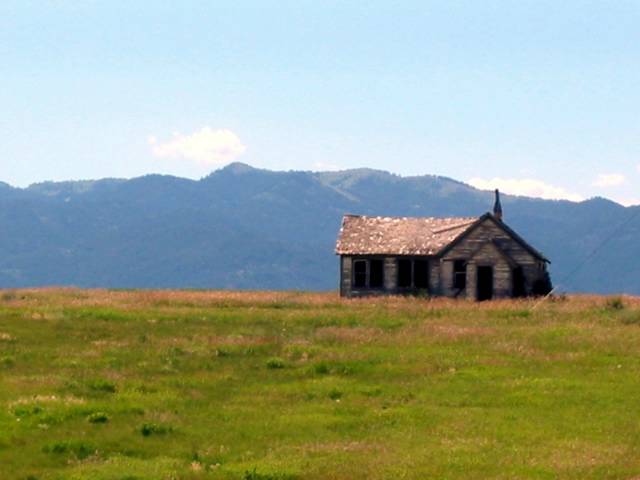
I had a great time at the big Braithwaite Reunion 2004. We went to West Piney Lodge, near Swan Valley, Idaho. I just love it up in that area - it's SO beautiful! I swear I could live in Victor, Driggs, or Swan Valley, even though they're so tiny.
And I love the Braithwaite side of the family. My cousin Debbie said it well, when she said that she was glad she belonged to a family where we actually like each other and get along, where you know that any of these people will accept you just as you are and do anything for you, because you're family. (She also reminded me that she could torture me for eternity because we're family - right after I made her Draw Two in UNO. :) ) They're a lot of fun, and the reunion was just wonderful.
I'm feeling absolutely tuckered out this evening. When I got home last night, I decided to watch a little TV and discovered that they were doing a mini-marathon of Wings on Nick at Nite. I just love that show! I used to never miss an episode when it was first being made, especially the earlier ones. (Is there any show I've liked that actually got better over the years? Hmm ... nope, can't think of a-one!) Anyway, I ended up staying up until 2:30 to watch some of those, and I'm feeling it now. Hey, at least I didn't have to go to work today, right?
I took some great pictures while I was in Idaho this last time. I have to put a few of them up on the web, in particular so that I can use one of them for my desktop at work for these last three weeks. :D
And I love the Braithwaite side of the family. My cousin Debbie said it well, when she said that she was glad she belonged to a family where we actually like each other and get along, where you know that any of these people will accept you just as you are and do anything for you, because you're family. (She also reminded me that she could torture me for eternity because we're family - right after I made her Draw Two in UNO. :) ) They're a lot of fun, and the reunion was just wonderful.
I'm feeling absolutely tuckered out this evening. When I got home last night, I decided to watch a little TV and discovered that they were doing a mini-marathon of Wings on Nick at Nite. I just love that show! I used to never miss an episode when it was first being made, especially the earlier ones. (Is there any show I've liked that actually got better over the years? Hmm ... nope, can't think of a-one!) Anyway, I ended up staying up until 2:30 to watch some of those, and I'm feeling it now. Hey, at least I didn't have to go to work today, right?
I took some great pictures while I was in Idaho this last time. I have to put a few of them up on the web, in particular so that I can use one of them for my desktop at work for these last three weeks. :D
Wednesday, July 28, 2004
HulaStan: the "best invitation ever"
Recently we had a Hawaiian-themed work party (fondly known as "The Luau"). Steve, one of our managers down here, and our System Administrator, got together with one of the graphic designers and created a little game to remind people of the time, place, etc. He used the face of Stan, the Resource Manager in our department, and the game requires you to make Stan hula the same steps as the hula girls on either side of him. It's pretty entertaining.
Ignore the little note that tells you to email Steve with your score, but do drop me a line and let me know if you ever get over 4000. Enjoy!
HulaStan
Ignore the little note that tells you to email Steve with your score, but do drop me a line and let me know if you ever get over 4000. Enjoy!
HulaStan
Tuesday, July 27, 2004
Tix!
Last night I finally bought my ticket to London for the fall. This means that I really am going to England. Even if I only stay a few weeks and come back in October because I procrastinated too long and was unable to get sufficient funding together, or to actually get a visa for the UK. But in any case, I am definitely going!
In other news, we had a work party tonight, and I won the Eye Spy game. They took pictures of about 30 Development employees and cropped them so you could only see their eyes, and then you had to guess who they all were. I got a perfect score, and they gave me a $1o gift certificate to Jamba Juice.
And, in yet other news, I got to see Katie Bills for a good day or so. She came in to town with her dad -- he for business conferences, she for a job interview in Nevada. We went to the Bombay House last night and had a blast. She also came to the party with me tonight and helped me keep score on the Jeopardy game that Josh and I put together. It was good times, good times.
In other news, we had a work party tonight, and I won the Eye Spy game. They took pictures of about 30 Development employees and cropped them so you could only see their eyes, and then you had to guess who they all were. I got a perfect score, and they gave me a $1o gift certificate to Jamba Juice.
And, in yet other news, I got to see Katie Bills for a good day or so. She came in to town with her dad -- he for business conferences, she for a job interview in Nevada. We went to the Bombay House last night and had a blast. She also came to the party with me tonight and helped me keep score on the Jeopardy game that Josh and I put together. It was good times, good times.
Sunday, July 25, 2004
LiveJournal ...
I know, I've left this blog empty for quite some time, with no updates for about a month now. Sorry about that. The main reason is because Emily convinced me to start a LiveJournal instead. Well, not instead. In addition. But it's take me some time to get it up and running. And that's why I've let my blog fall into disrepair, as it were. In the future I will be double-posting, so you can read my updates at either my blog (here) or my LiveJournal.
For tonight, though, I'm tired, and so I'll just post a link so that you can get to my LiveJournal if you want.
My LiveJournal
For tonight, though, I'm tired, and so I'll just post a link so that you can get to my LiveJournal if you want.
My LiveJournal
Wednesday, July 7, 2004
Can't Wait!
Today I woke up and looked at my calendar. This weekend is Paul's birthday part, which I'm very excited to attend. Then the weekend after that is the Ward "Rodeo" at the bishop's ranch, apparently an event not to be missed! The next weekend is Pioneer Day and I'll be going down to the Shakespearean Festival (hereafter known in this blog as the ShakeFest) with Jen and Emily, which I can hardly wait for!! SO pumped for that! The next weekend is the beginning of the big Braithwaite Family Reunion at West Piney, which should be fabulous, as it always is. And once I get home from that, I only have two more weeks until my housing contract runs out. So far, that's been the date I've been expecting to leave work, but now I'm not so sure. Paul and Christina generously offered the use of their home for a few weeks if necessary, so I might stay until around September 3. But I don't konw if I can take work for that much longer. Actually, I must say that things have been significantly better the last little while. For a while there it was extremely stressful, partly just because I was the only senior developer around, and all of the managers were gone, so I got stuck with a lot of huge projects. But most of that has been spread out with others lately, and in fact, I sometimes feel like I don't really have that much to do anymore, which makes some things a little more bearable.
In the meantime, I downloaded Mozilla's Firefox browser today, which I really like. Paul recently installed it at work, and today he installed it on my work computer, and it's been quite nice. For one thing, it's not at all connected with Microsoft, which is always something I'm in favor of. I often wish that I could more of my applications away from MS, but it's often really difficult to do, just because they've become the industry standard in so many venues. For example, I would have bought an iMac instead of Ladislaw (my trusty and loyal PC laptop), but I found that the Lancaster campus doesn't support Macs. Almost everything out there is MS-based. But Firefox I can do. :) And it allows me to block ads and stuff, and that's cool.
In the meantime, I downloaded Mozilla's Firefox browser today, which I really like. Paul recently installed it at work, and today he installed it on my work computer, and it's been quite nice. For one thing, it's not at all connected with Microsoft, which is always something I'm in favor of. I often wish that I could more of my applications away from MS, but it's often really difficult to do, just because they've become the industry standard in so many venues. For example, I would have bought an iMac instead of Ladislaw (my trusty and loyal PC laptop), but I found that the Lancaster campus doesn't support Macs. Almost everything out there is MS-based. But Firefox I can do. :) And it allows me to block ads and stuff, and that's cool.
Sunday, July 4, 2004
PPP done, still under construction
OK, I finished the PPP "article" and posted it. I decided to do it all as one big post with internal links so that it's easier to find certain sections if that's what you want to do. However, it seems that these internal links are currently not functioning. I'll take a look and see if I can get them to work in the next few days.
I also tried to publish the figures so that they would appear in the correct ascending numbered order after the article, but for some reason, Hello published them in a different order than I wanted. Don't know what's up with that. They're supposed to also link internally, and the links are not working, so I'll look at those as well. Theoretically, they should work, based on what I've done with other blogs.
I know it's long, but I think it will be helpful to a lot of people as I continue to prattle on about people's colors and such in the future. It will be good to have someplace on the web where I can point people and have them at least get the basics of what I'm talking about.
Also, I am not the world's foremost authority on Peirce, but this is the paradigm as I understand it, and the point here was to help people know what I am talking about ... please don't take this to be more than it is. It is just some useful information, but it certainly is not academic or even well-researched.
I also tried to publish the figures so that they would appear in the correct ascending numbered order after the article, but for some reason, Hello published them in a different order than I wanted. Don't know what's up with that. They're supposed to also link internally, and the links are not working, so I'll look at those as well. Theoretically, they should work, based on what I've done with other blogs.
I know it's long, but I think it will be helpful to a lot of people as I continue to prattle on about people's colors and such in the future. It will be good to have someplace on the web where I can point people and have them at least get the basics of what I'm talking about.
Also, I am not the world's foremost authority on Peirce, but this is the paradigm as I understand it, and the point here was to help people know what I am talking about ... please don't take this to be more than it is. It is just some useful information, but it certainly is not academic or even well-researched.
An Introduction to the Peircean Paradigm
Author's Notes*
A NOTE on the functionality of links: In order for the internal links in this "article" to really work right (particularly the links to figures), you should view this post in the July 2004 archive. Use the link on the side-bar (over on your right) to view only the July 2004 posts, and then scroll down until you find this article again. The links will work much better, and you will be much happier!
THE SECTIONS:
I. The Basics
II. Peirce in Plot: The First Love-story
III. Peirce in Characterization
a. The Four-Place System
b. The Seven-Place System
IV. Conclusion
V. Further Reading
THE COLORS:
yellow
red
blue
orange
green
purple
black/white/grey
I. The Basics
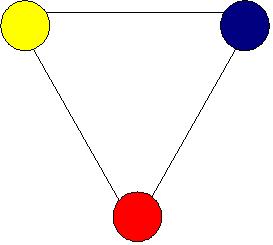
C. S. Peirce wanted to find a way to categorize everything conceivable in the universe. The way he went about this was to create a system based on three categories, which are then expandable to about any number necessary. Peirce says that nothing in the universe really exists unless it has an opposite; and if these two opposites exist, then there is a third thing that ties these two together. The Peircean paradigm is based on these three categories.
(1) The first category is yellow**. Yellow is potential: it is the sun in the morning, it is creativity, it is innovation, art, possibility, it is the road stretching out before you.
(2) The second category is red. Red is conflict: it is the blood on the ground, it is aggression, it is anger, lust, rebellion, action, it is the monster standing in the road and blocking your progress.
(3) The final, third category is blue. Blue is law: it is the distant sky, it is trust, it is self-comprehension, it is community, language, perfection, it is the horizon toward which we all strive.
Wherever something exists in potentia, there is always something that opposes it, and there is always something else that binds these two together.
(See Figure 1)
II. Peirce in Plot: The First Love Story
Nearly every story out there in the world is based on these categories, as I’m about to demonstrate. However, in order for this story to work, we need a fourth category.*** Just as with paints, we can “mix” these categories to get new ones.
(4) Orange (yellow + red) includes the creativity and possibility of yellow as well as the aggressiveness of red. It is vibrant, colorful, full of potential, intuitive, quick-tempered, and active. On the other hand, it is the “opposite” of blue, so it is faulty, imperfect, unguided by rules, and non-committal.
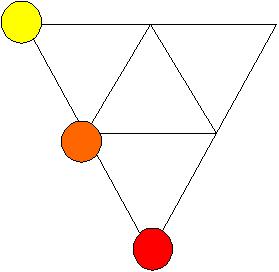
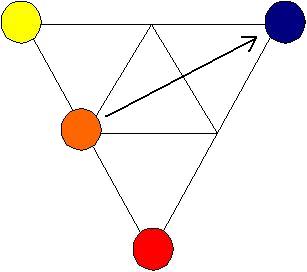
Our story takes place in caveman times, before language is in use, and long before music has been invented. Now, our plot begins with our main character (orange) wanting something: in this case, a woman (yellow). However, there is someone else who also wants this woman, and he blocks our hero’s way (red): he is bigger, stronger, faster, and meaner, and our hero has no way around him.
Every time our hero tries to get near his goal (the yellow woman), his opponent (the red man) beats him off. Our man tries everything he can think of: surprise, tactic, speed. All to no avail.
But then our hero tries something new. He invents language and speaks to his woman. Now he can talk to her of the future, he can promise her comfort, speak of his undying love, and make vows of commitment. The woman is swayed by his persuasive speech, and she leaves, this time of her own will, to follow him into the blue distance. Only by changing his orange nature into blue (its complementary color, incidentally) is our hero able to overcome his red opponent and finally reach his goal.
This is the basic outline of any good plot (including our own – but that’s a conversation for another day). Look for it. Well-done plots always follow this basic outline. However, there are many different types of plots that can fit this paradigm (a friend of mine did her thesis on ten major types of plot and how they fit the Peircean paradigm). Adventure, self-discovery, creation, discovery: all good plots use this same basic outline. Orange wants yellow, but is blocked by red; orange must convert to blue in order to reach its goal (see Figure 3).
III. Peirce in Characterization
a. The Four-Place System
The Peircean categories can be used to categorize character types, as we’ve seen briefly during the plot description above. Many stories use just these main four characters and call it good, particularly in television sit-coms. It is important to note here that, while it is true that the orange character must become blue to resolve a plot, sit-coms usually try to avoid full resolution for many seasons at a time. Within each episode (sub-plot), there is a resolution of sorts, but in the bigger picture (the run of the show) there often is no real resolution. This means that the blue in a sit-com is rather useless, often serving as a means of comic relief.
To demonstrate the use of this four-place system of character categorization, let’s look at the show Seinfeld. In this show, Jerry is the orange character: he is the center of attention (something that oranges often seek out), he is impulsive, creative, non-committal. Elaine is yellow: she is full of potential, and she represents something (women) that the others spend much of their time trying to get. George is red: he is aggressive, quick-tempered, and rather rebellious when it comes to social conventions. Kramer is blue, in this case because he’s useless. He offers us a balance of characters, but not an ideal to strive for. His understanding of his place in the universe is so complete that he cares only minimally about others’ opinions of himself, which allows him to behave in a manner bordering on institutional insanity, and yet we find it entertaining. (See Figure 4.)
b. The Seven-Place System
We have already seen how we can combine yellow and red to create orange. If we take a little blue and mix it with the these three colors, we create three new colors (see Figure 5).
(5) Green (yellow + blue) combines the creativity and potential of yellow with the regulation of blue. Green is self-discovering, reflective, and often manipulative. Green, as the “opposite” of red, seeks to avoid conflict, high emotion, and rebellion.
(6) Purple (red + blue) combines the aggression and rebelliousness of red with the regulation and idealism of blue. Purple is active, but likes to follow the rules as well; it quickly judges the situation and acts in accordance with proven or approved law. As the “opposite” of yellow, purple prefers rules and regularity over creativity and spontaneity.
(7) Black, grey, or white (depending on medium and shade) is the combination of orange and blue.**** It combines two things that are essentially opposite and makes for some major complication. Black is the epitome of evil, white is the essence of good, and grey fluctuates or is neutral between these two. Black wants to be evil, wants to be perceived as evil, and will go to any lengths to accomplish this goal. On the other hand, white wants to be good, wants to be perceived as good, and will go to any lengths to accomplish this goal. Grey is neither good nor evil, but remains a neutral player in the scene, and is thus rather rare in literature. Whatever ends up in this center position tends to be the thing or person that drives the main action of the plot.
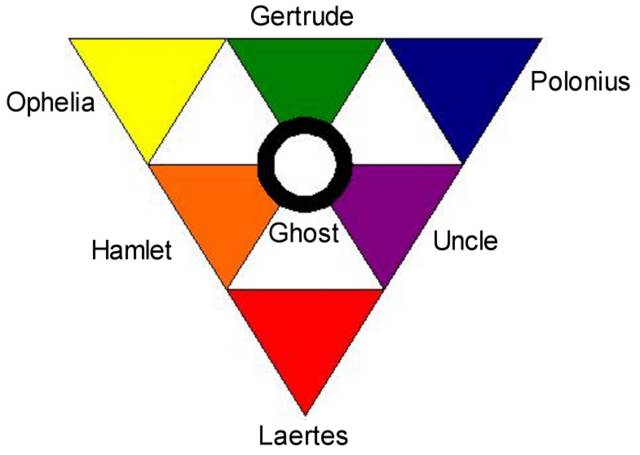
Much of literature uses these seven characters to further balance out the story. A classic case is Shakespeare’s much-beloved Hamlet (see Figure 6). In this case, Hamlet is orange, his mother (Queen Gertrude) is green, and his uncle is purple. Ophelia, the woman Hamlet loves, is yellow; Laertes, Ophelia’s brother who tries to prevent her from loving Hamlet, is red; and Polonius, the long-winded advisor to the king, is blue. Hamlet’s father’s ghost is the center position, and an interesting question about the play comes about when we ask ourselves whether the ghost is black, white, or grey. Does he know that his request for revenge will lead to the deaths of all of these major characters, but ask it anyway (black)? Or does he hope that Hamlet’s attempts to find out what really happened will lead to unity between his family (white)? Or is he just a ghost who wants some revenge, without really thinking about the consequences (grey)? In any case, it is clear that without the ghost’s intervention in the story, not much of a plot would be going on.
IV. Conclusion
The Peircean paradigm can explain a lot about the stories we read and help us to find patterns we might not otherwise see. It can also help to explain some things about good literature and bad literature: often bad literature is bad because it doesn’t follow these paradigm standards, and as much as we like to think that we can do without them, that just makes for poor characters or plots.
See what you can find about some of the literature you read using this paradigm. And please, PLEASE write me with any questions or comments you might have about Peirce. I always love teaching others about it, and I also love learning more about it myself from others.
V. Further Reading
If you’d like to learn a little more about Peirce, might I suggest the following:
1. Dr. Alan Manning’s Linguistics 230 (cob-)website. This site is really old and it may not be around much longer, but if you take the time to look around it a little, you’ll find some really great explanations of the Peircean categories, as well as their application to a lot of linguistic and other real-world contexts.
2. A Thief of Peirce: The Letters of Kenneth Laine Ketner and Walker Percy. I frankly don’t know who publishes this book, and I also haven’t read it yet. But I’ve been told it’s one of the best places to start if you want to understand Peirce. It’s high up on my priorities list, but it hasn’t made it into my hands just yet.
3. Peirce’s writings at the www.peirce.org website. Not for the faint of heart! So far, this site only has one piece up and running on the web, “On a List of New Categories”, but it’s good reading. I suggest printing it, making copious notes, and then re-reading it, paragraph by paragraph to make sure you “get” it. I don’t know many people who really do “get” it, even after a life-time of study, so be prepared for some serious reading here. If you manage it, you might want to try some of the other articles listed on the site.
4. How to make our ideas clear, article by Peirce. See comments on #4 above.
---------------------------
NOTES
*I have developed the habit over the years of quoting people constantly when I write – and quite naturally, too, as this is expected in academic writing. But today I wanted to challenge myself to write completely without reference to specific books or conversations. Now, all of the stuff I’ve written here, while it came directly from my head, was originally put there by someone else, but I’m trying to share my personal knowledge and understanding of Peirce. For now, just know that nothing here quite originated with myself, but must be attributed to someone else, particularly Charles S. Peirce (obviously), Dr. Alan Manning (of the BYU Linguistics Department), and Jessica Young.
**Peirce used numbers to differentiate his categories, but most people (including myself) find it easier to work with colors, so that’s what I will use here.
***The reason for this is because the first three categories by themselves are perfectly balanced, but a plot does not progress unless it begins out of balance and moves on to balance itself (see Figure 2 and Figure 3).
****It is true that this can also be seen as the combination of yellow and purple, or of red and green, but these perspectives change little about the nature of the black/grey/white category.
A NOTE on the functionality of links: In order for the internal links in this "article" to really work right (particularly the links to figures), you should view this post in the July 2004 archive. Use the link on the side-bar (over on your right) to view only the July 2004 posts, and then scroll down until you find this article again. The links will work much better, and you will be much happier!
THE SECTIONS:
I. The Basics
II. Peirce in Plot: The First Love-story
III. Peirce in Characterization
a. The Four-Place System
b. The Seven-Place System
IV. Conclusion
V. Further Reading
THE COLORS:
yellow
red
blue
orange
green
purple
black/white/grey
I. The Basics
C. S. Peirce wanted to find a way to categorize everything conceivable in the universe. The way he went about this was to create a system based on three categories, which are then expandable to about any number necessary. Peirce says that nothing in the universe really exists unless it has an opposite; and if these two opposites exist, then there is a third thing that ties these two together. The Peircean paradigm is based on these three categories.
(1) The first category is yellow**. Yellow is potential: it is the sun in the morning, it is creativity, it is innovation, art, possibility, it is the road stretching out before you.
(2) The second category is red. Red is conflict: it is the blood on the ground, it is aggression, it is anger, lust, rebellion, action, it is the monster standing in the road and blocking your progress.
(3) The final, third category is blue. Blue is law: it is the distant sky, it is trust, it is self-comprehension, it is community, language, perfection, it is the horizon toward which we all strive.
Wherever something exists in potentia, there is always something that opposes it, and there is always something else that binds these two together.
(See Figure 1)
II. Peirce in Plot: The First Love Story
Nearly every story out there in the world is based on these categories, as I’m about to demonstrate. However, in order for this story to work, we need a fourth category.*** Just as with paints, we can “mix” these categories to get new ones.
(4) Orange (yellow + red) includes the creativity and possibility of yellow as well as the aggressiveness of red. It is vibrant, colorful, full of potential, intuitive, quick-tempered, and active. On the other hand, it is the “opposite” of blue, so it is faulty, imperfect, unguided by rules, and non-committal.
Our story takes place in caveman times, before language is in use, and long before music has been invented. Now, our plot begins with our main character (orange) wanting something: in this case, a woman (yellow). However, there is someone else who also wants this woman, and he blocks our hero’s way (red): he is bigger, stronger, faster, and meaner, and our hero has no way around him.
Every time our hero tries to get near his goal (the yellow woman), his opponent (the red man) beats him off. Our man tries everything he can think of: surprise, tactic, speed. All to no avail.
But then our hero tries something new. He invents language and speaks to his woman. Now he can talk to her of the future, he can promise her comfort, speak of his undying love, and make vows of commitment. The woman is swayed by his persuasive speech, and she leaves, this time of her own will, to follow him into the blue distance. Only by changing his orange nature into blue (its complementary color, incidentally) is our hero able to overcome his red opponent and finally reach his goal.
This is the basic outline of any good plot (including our own – but that’s a conversation for another day). Look for it. Well-done plots always follow this basic outline. However, there are many different types of plots that can fit this paradigm (a friend of mine did her thesis on ten major types of plot and how they fit the Peircean paradigm). Adventure, self-discovery, creation, discovery: all good plots use this same basic outline. Orange wants yellow, but is blocked by red; orange must convert to blue in order to reach its goal (see Figure 3).
III. Peirce in Characterization
a. The Four-Place System
The Peircean categories can be used to categorize character types, as we’ve seen briefly during the plot description above. Many stories use just these main four characters and call it good, particularly in television sit-coms. It is important to note here that, while it is true that the orange character must become blue to resolve a plot, sit-coms usually try to avoid full resolution for many seasons at a time. Within each episode (sub-plot), there is a resolution of sorts, but in the bigger picture (the run of the show) there often is no real resolution. This means that the blue in a sit-com is rather useless, often serving as a means of comic relief.
To demonstrate the use of this four-place system of character categorization, let’s look at the show Seinfeld. In this show, Jerry is the orange character: he is the center of attention (something that oranges often seek out), he is impulsive, creative, non-committal. Elaine is yellow: she is full of potential, and she represents something (women) that the others spend much of their time trying to get. George is red: he is aggressive, quick-tempered, and rather rebellious when it comes to social conventions. Kramer is blue, in this case because he’s useless. He offers us a balance of characters, but not an ideal to strive for. His understanding of his place in the universe is so complete that he cares only minimally about others’ opinions of himself, which allows him to behave in a manner bordering on institutional insanity, and yet we find it entertaining. (See Figure 4.)
b. The Seven-Place System
We have already seen how we can combine yellow and red to create orange. If we take a little blue and mix it with the these three colors, we create three new colors (see Figure 5).
(5) Green (yellow + blue) combines the creativity and potential of yellow with the regulation of blue. Green is self-discovering, reflective, and often manipulative. Green, as the “opposite” of red, seeks to avoid conflict, high emotion, and rebellion.
(6) Purple (red + blue) combines the aggression and rebelliousness of red with the regulation and idealism of blue. Purple is active, but likes to follow the rules as well; it quickly judges the situation and acts in accordance with proven or approved law. As the “opposite” of yellow, purple prefers rules and regularity over creativity and spontaneity.
(7) Black, grey, or white (depending on medium and shade) is the combination of orange and blue.**** It combines two things that are essentially opposite and makes for some major complication. Black is the epitome of evil, white is the essence of good, and grey fluctuates or is neutral between these two. Black wants to be evil, wants to be perceived as evil, and will go to any lengths to accomplish this goal. On the other hand, white wants to be good, wants to be perceived as good, and will go to any lengths to accomplish this goal. Grey is neither good nor evil, but remains a neutral player in the scene, and is thus rather rare in literature. Whatever ends up in this center position tends to be the thing or person that drives the main action of the plot.
Much of literature uses these seven characters to further balance out the story. A classic case is Shakespeare’s much-beloved Hamlet (see Figure 6). In this case, Hamlet is orange, his mother (Queen Gertrude) is green, and his uncle is purple. Ophelia, the woman Hamlet loves, is yellow; Laertes, Ophelia’s brother who tries to prevent her from loving Hamlet, is red; and Polonius, the long-winded advisor to the king, is blue. Hamlet’s father’s ghost is the center position, and an interesting question about the play comes about when we ask ourselves whether the ghost is black, white, or grey. Does he know that his request for revenge will lead to the deaths of all of these major characters, but ask it anyway (black)? Or does he hope that Hamlet’s attempts to find out what really happened will lead to unity between his family (white)? Or is he just a ghost who wants some revenge, without really thinking about the consequences (grey)? In any case, it is clear that without the ghost’s intervention in the story, not much of a plot would be going on.
IV. Conclusion
The Peircean paradigm can explain a lot about the stories we read and help us to find patterns we might not otherwise see. It can also help to explain some things about good literature and bad literature: often bad literature is bad because it doesn’t follow these paradigm standards, and as much as we like to think that we can do without them, that just makes for poor characters or plots.
See what you can find about some of the literature you read using this paradigm. And please, PLEASE write me with any questions or comments you might have about Peirce. I always love teaching others about it, and I also love learning more about it myself from others.
V. Further Reading
If you’d like to learn a little more about Peirce, might I suggest the following:
1. Dr. Alan Manning’s Linguistics 230 (cob-)website. This site is really old and it may not be around much longer, but if you take the time to look around it a little, you’ll find some really great explanations of the Peircean categories, as well as their application to a lot of linguistic and other real-world contexts.
2. A Thief of Peirce: The Letters of Kenneth Laine Ketner and Walker Percy. I frankly don’t know who publishes this book, and I also haven’t read it yet. But I’ve been told it’s one of the best places to start if you want to understand Peirce. It’s high up on my priorities list, but it hasn’t made it into my hands just yet.
3. Peirce’s writings at the www.peirce.org website. Not for the faint of heart! So far, this site only has one piece up and running on the web, “On a List of New Categories”, but it’s good reading. I suggest printing it, making copious notes, and then re-reading it, paragraph by paragraph to make sure you “get” it. I don’t know many people who really do “get” it, even after a life-time of study, so be prepared for some serious reading here. If you manage it, you might want to try some of the other articles listed on the site.
4. How to make our ideas clear, article by Peirce. See comments on #4 above.
---------------------------
NOTES
*I have developed the habit over the years of quoting people constantly when I write – and quite naturally, too, as this is expected in academic writing. But today I wanted to challenge myself to write completely without reference to specific books or conversations. Now, all of the stuff I’ve written here, while it came directly from my head, was originally put there by someone else, but I’m trying to share my personal knowledge and understanding of Peirce. For now, just know that nothing here quite originated with myself, but must be attributed to someone else, particularly Charles S. Peirce (obviously), Dr. Alan Manning (of the BYU Linguistics Department), and Jessica Young.
**Peirce used numbers to differentiate his categories, but most people (including myself) find it easier to work with colors, so that’s what I will use here.
***The reason for this is because the first three categories by themselves are perfectly balanced, but a plot does not progress unless it begins out of balance and moves on to balance itself (see Figure 2 and Figure 3).
****It is true that this can also be seen as the combination of yellow and purple, or of red and green, but these perspectives change little about the nature of the black/grey/white category.

Subscribe to:
Posts (Atom)
